
 Famous Faces, Famous Places and Famous Foods


Part 2: A Cyclist’s Cuba
Cuba Part 2
(Part 1 http://www.greatestescapes.com/index.php?articleid=391&page=1&issue=)
A beach track interspersed with crabs leads along a rocky coast. We are once again dreading a hungry night and are not relishing another meal of Clif bars imported from home. A Cuban family celebrating their father’s birthday greet us at a swim hole. Please have some rum and come swim with us, they cry. Stay awhile, they continue, we can't possible eat the roast suckling pig and all this food by ourselves.
We feel bad. Unable to communicate in Spanish. But Hans had his digital camera. They can't get enough of Hans’ digital images. We eat like kings. What wonderful hosts. The Cubans have so little but their hearts are always open. After a brief farewell we continue on as the crabs resume their dusk march across the coastal lands. We have squashed hundreds. The bikes are covered in crab eggs and crab juice. The vultures are having a field day. But in this heat it doesn't smell. They dry quickly and passing cars turn the dried remains into a wind of tiny dried crab bits.
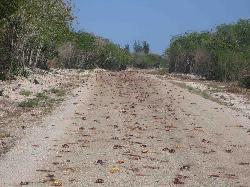
The crabs are getting worse. The all-inclusive day beach is infested. Crabs sit on the lawn chairs, swing from the rafters, peer down from the roof, force there way through the shutters and torment the dog.
Flat tires are a regular occurrence from the thorns. One of us defends the bikes from crabs while the other one repairs the flat. Not that the crabs attack, but they move in for shade, hiding under bikes and panniers, cozying up to feet, then when disturbed get all defensive. We are told the road beyond Playa Larga is impassable because of crabs. We go anyways. On to Playa Giron where the Americans tried to invade and now a tourist cesspool. Past a billboard that commemorates the 30th anniversary of the victory of the Vietnam War. Through the swamp as it gets dark. Past the crocodile farms with their dogs that chase us for miles yapping at our heels in the darkness. Past the scrub fires that glow red in the dark. In desperation we reach Central Australia (Cuban towns have strange names) and a Casa Particular. On the journey my rear tire has blown out (sending the Cubans on the roadside for cover as they hear the explosion that rips my sidewall apart). A spoke has snapped, a valve has pulled out of my tube from the constant patches from thorns and crab bits. What a mess. A Cuban ponchero later put a new valve on my tube and patches my tire sidewall.
Tired and not wanting to ride 150-km of cane field scenery we decide to hitch-hike to Havana. Simple really. Go see a government agent in yellow, tell him our destination, bribe him (since it is illegal for foreigners to hitch) and 15-minutes later hop onto a flat bed semi trailer with gaping holes in the bed and flimsy metal sides that look like they are ready to spill our bikes, and Hans, and forty Cubans traveling with us onto the highway.
Havana
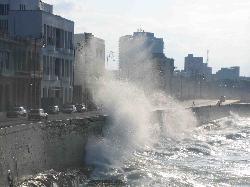
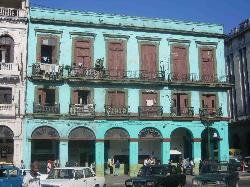
In its heyday this city of two million was a lavish den of mafia, gambling, prostitutes and wealth. Then Castro moved in. He confiscated all the businesses. The now bitter, wealthy white Cubans moved to Miami. Havana has not been the same since. No upkeep was done on any Havana buildings leaving opulent colonial architecture to topple. Balconies often collapsed killing innocent walkers below. No paint was to be had except on the black market. Buy black-market paint and lose your house for unauthorized improvements. Catch 22! Recently UNESCO and tourism moved in and the buildings are being repaired with tourism profits. The oldest part of town is now a chi chi tourist trap of glitzy bars, good music and opulent hotels. Fidel watches from his mansion. All the roads conveniently lead one way. The wrong direction from his discreet abode.
In Havana we stay at the exquisite Hotel Centifico. Previously a president’s house this grand building is complete with a magnificent marble staircase, 20-ft. ceiling, Romanesque statues and antique furnishing. It should be a museum except it is like every other building in Havana. Complete with the Cuban standard lack of toilet seat and water taps that emit no more then a steady drip. I will never forget my only hot Cuban shower. The electric water heater attached to the showerhead working overtime to provide hot water. The jury-rigged power chord glowing red above my head. The smell of burning plastic insulation wire making me glad I hadn’t taken time to shampoo yet. But at least that bathroom had a door.
Before we leave Cuba we have one more side trip to make. The great rejuvenating hot springs of San Diego de los Banos.
San Diego de los Banos
A town home to a Soviet-era hot springs. The institutional building looked nice enough. The bureaucrat in charge gladly takes the $4 entry fee with the assistance of management and about five other employees. Forms are signed, supervisors called to witness the signing, paperwork filed, the cash manager summoned to provide change, and finally we are in. We are led down a spiral ramp into the musty sulphur smelling bowels of the building. The ramp circles down past three levels of peeling paint, jury-rigged lights, and musty smells. At the bottom level a lady nestled in a big armchair blocking the passageway greets us and leads us to individual change booths. Sunlight streams in from a void into this monstrous room. The change booths have doors half hanging from hinges and benches cracked in half but it is clean like a scene from a derelict facility in the video game “Doom”. Another woman is summoned and we are led to the communal pools. A lovely oval tiled pool with clear 30-degree water awaits us. It feels so good and so cold after the heat of the day.
Back on the bikes we apply more sunscreen. Strangely rubbing it on my legs results in my palms covered in fallen out leg hair. I don’t know what is in that water but it could explain why the communal pool was empty and the facility long forgotten.
Homeward bound.
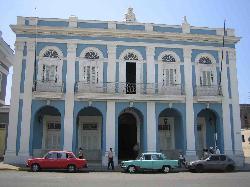
Cuba is slowly coming out of the special period (so named for the hardships Cubans faced after the aid collapse of the Soviet Union). Only in Pinar del Rio did we experience regular black outs. It is eerie to walk the streets of a dark city, taking our life in hand as we crossed the road praying that we would not be hit by an unlit flying bicycle pedaled by some Cuban who seemed to be late for everything. Western products are once again flowing. Of course the kids still use sticks and rocks to play baseball but potential Olympic athletes cruise by on expensive racing bikes or get “real equipment”. The best and biggest Cuban supermarkets still contain five times less selection then the average American corner store. Pensioners still only get 17 pesos a months (under $1 Canadian). They tell me that goes a long way when the whole family lives in one room. But no one starves. There are no beggars, health care is free, and the mentally handicapped are seen but are taken care of. No drugs, glue sniffing or crimes that plague our society. Most people seem genuinely happy and willing to help strangers. Cubans are possibly the nicest, happiest people on earth.
When you go:
There are two great books on cycling Cuba. We preferred:
Lonely Planet’s Cycling Cuba by Rosa Daren, Daren Choukalos
And highly recommended:
Moon Handbooks Cuba by Chris Baker