
 Famous Faces, Famous Places and Famous Foods


A Cyclist's Cuba
Varadero is not Cuba. The Cubans there are afraid to look at you, to talk to you. Cubans are barred from the beach. Senoritas caught in a house with a foreign male are jailed and the house confiscated. The resorts are joint enterprises with foreign corporations and these corporations thoughtfully pay the government US$450 a month for each Cuban employee. The government in turn pays out minimum wage ($22 a month) to their employees. Cuban educated professionals flock to work as hotel staff. Chances are the desk girl is a doctor, or teacher, as the tips can make them wealthier than any other job. Castro announced last Friday that no more teachers, doctors, or nurses may be employed in tourism. You see, suddenly there is a shortage of professionals.
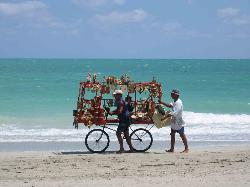
But let's not dwell on the lack of freedom, outrageous rules, or incredible beaches of Varadero. As a tourist you aren't supposed to know any of that. Go back to your buffets, swim in the warm turquoise sea, dance the night away at your Cuban-free discos and just ignore me. My traveling companion Hans Selde and I fled as fast as we could. By law we had to book two nights accommodation in advance and Varadero had seemed a good choice. After all, Cubans were once granted two weeks a year at places such as this before the Special Period began.
The bus to Trinidad is empty. Our bikes sit neatly in the hold. Beyond the gates of Varadero every street corner is lined with hitchhikers. Men in yellow uniforms organize rides and fill anything that can possibly hold people. We speed on in air-conditioned comfort to the autopista, a four-lane highway almost devoid of traffic. Mid-way we stop at a special tourist bar complete with Cuban band. I stand in the middle of the highway and marvel. Minutes go past without a vehicle marring the peace.
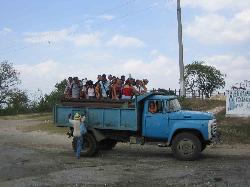
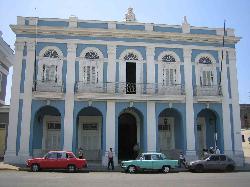
First stop Cienfuegos, a beautiful, run-down town filled with tractors, bikes, and beasts of burden punctuated with the heady exhaust of American cars from the 50's (amazing vehicles of excess dolled up with house paint and chrome shining). We briefly stop at a cemetery filled with marble graves from a more extravagant time. Unmaintained, many of the gravestones have cracked and the bones can be seen lying within.
Farther up the road a once beautiful botanical garden, now derelict, awaits us. The plants have grown to monstrous proportions and we run around like kids, drunk on Mojito's from the garden's tourist bar. We head by bike into the mountains as night falls. The cantinas are empty except for cigars and over-proof rum to satisfy our hunger cravings. The road becomes steep and rough and the locals tell us we are foolish to go to Trinidad through the mountains. The night is pitch black punctuated with lightening bugs trying to mate with our bike lights. We crawl along trying to avoid potholes and yapping dogs. Finally we set up our tent by the side of the road in a field of mimosa. Mimosa is a sensitive little plant that responds to touch and transforms instantly from a feathery plant to one that looks like a dead stick. As we sleep, only the occasional clip clop of a cowboy on horseback breaks the silence.
We must look miserable riding our bikes in the morning. A cowboy on horseback stops and insists we go see his wife for an espresso (or at least that's what we interpret with our limited Spanish). The wife invites us into her modest home and we watch as she makes coffee while chickens run around inside. It is a beautiful home by Cuban country standards (cement, brick, TV, furniture). We do our best to casually chat using only our Spanish phrase book. She brings out her English school textbooks.
A quick descent brings us to Trinidad's hustlers and prostitutes. (Ok, maybe only two prostitutes who kept on complimenting Hans’ shirt and asking if he likes them). Trinidad is a pretty town with cobblestone streets and a town square which hosts a local band each evening. Problem is there doesn't appear to be any Cubans enjoying the music. We wander off, and in the darker areas of the old town we meet the two prostitutes interested in Hans' shirt. After much confusing banter a man comes by and translates and offers his house for the "transaction." Hans replies no thanks but he would prefer if these two very sweet and innocent looking girls were to come to the main square and dance Salsa with us. Of course the answer is no because the square is crawling with cops and informers waiting to jail a Cuban woman foolish enough to sit with a foreign male. The subject turns to black market cigars and we are led back to his place for an illegal cigar purchase. All is good and I feel dangerous and devious.
Crabs
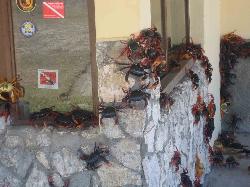
Infestations of them. More than you can possibly count. Pink ones, red ones, dead ones, live ones. The roads are crawling with them. You hear their claws in the underbrush, an eerie sci-fi scraping of an alien invasion. Armies of crustaceans crossing the highways. Too many to avoid. Dodge one, hit two. Some will run towards you, some away. No way to predict. You can hear the twang as they reach up and bite the spokes. You can feel them biting at the bottom of your shoes and pedals.
We ride past Nuclear City. We dare not ride through town as on the outskirts the residents come out of the apartments to stare at us in a sinister sort of way. Beyond are the two reactors, one only $30 million from completion. It rises out of the scenery like a deserted Star Wars base. We ride past the ruined security gate and count our blessings that we can approach close enough to read the ‘Viva Fidel’ graffiti on the reactor's external walls. A Cuban with an ancient machine gun steps from the shadows to greet us. No photos, come no closer, is his simple message. I am dieing to bribe the Cuban for a tour but Hans thinks it unwise. He is right, there is probably a small army documenting our every move.
When you go:
There are two goods books on cycling Cuba. We chose:
Lonely Planet's Cycling Cuba by Rosa Daren, Daren Choukalos
And supplemented it with:
Moon Handbooks Cuba by Chris Baker's
Next issue Part 2