
 Famous Faces, Famous Places and Famous Foods


One Magnificent Walk: A Costa Rican Adventure and a Fiery Volcano
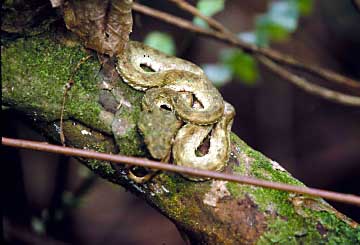
"Look, there on the branch. Boca Raca," my Costa Rica guide Paulo warns me.
"What does Boca Raca mean?" I ask, peering into the fragrant guava tree.
"It translates into stick that kills when biting," he smiles.
I pull back. Coiled in the shady maze of branches is one of Costa Rica's poisonous snakes. His triangle head sports little spikes that curl up from each corner of his eyelid.
"Boca Raca's watching your every move," Paulo whispers. "He'll wait two weeks on that branch. For a lizard lunch, or a tourist finger."
We're hiking Los Tucanes Trail in Arenal Volcano National Park. A noisy universe of snakes, spiders, beetles, butterflies, leafcutter ants, monkeys, sloths, peccaries, and 800-plus species of birds. Leaves bigger than me. Almost no people. All 700,000 of them are several hours south in Costa Rica's capital city, San Jose.
Balancing on slippery rocks, we cross a frothing white river, then clamber up the muddy path. Lacy ferns tickle my legs, moss decorates graceful trees vaulting skyward. Paulo picks a wild raspberry, offering me a rainforest snack.
 "Make sure there's no stink bug inside the fruit before you eat it," Paulo jokes. "They're not so tasty." He crouches on the trail, examining a paw print. "Ocelot. Fresh, this morning. Might still be around."
A sexy wolf whistle interrupts the insect chorus. A familiar sound, reminds me of what I heard walking past city construction sites when I was a cute young thing.
"That's a squirrel cuckoo," Paulo tells me. "They always notice pretty women."
He's charming, this Paulo Valerio. Once Paulo starts tracking "his" birds, there's no end to it. If he considers you a deepcore birder, he'll find you 315 species on two days of rainforest hikes: Black crested coquette hummer, red rumped tanager, chestnut mandible toucan, resplendent quetzal... He knows Costa Rica's birds by their voice, the shape of their wings in flight. Even a bird camouflaged in dense foliage can't escape his eyes. In a flash, he's set up his swank Swarovski Optik spotting scope, showing me a beak or tail close-up. Flipping through his leather bound "bible" — A Guide to the Birds of Costa Rica — Paulo points at the bird's illustration and description of habitat, diet, behavior. His dog-eared guide is autographed by authors F. Gary Stiles and Alexander F. Skutch and book marked with a black-hawk feather. Office and home telephone numbers are carefully inscribed on the inside cover should Paulo be accidentally separated from his sacred tome.
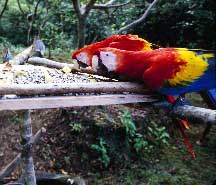 A mellifluous gurgle pierces the rainforest stillness. "Montezuma Oropendola," Paulo calls out. Turning in a circle, the trees, leaves, bushes, blur into a kaleidoscope of green. A second laugh. Paulo's scope points at a six-foot pouch hanging from a branch. A huge black bird shoots out, perching near us flashing a red beak, white cheek, and yellow tipped tail. "I've decided you were a bird in your former life Paulo. The way you spot them is amazing," I say.
"No, I was a tree," he counters. "I was hospitable to birds. So now I'm able to see them."
And now in the rainforest, we are treated to… rain.
"We had nineteen feet of rain here last year," Paulo laughs, pulling on his Gortex jacket.
Scrambling uphill, we're surrounded by hundreds of lava boulders. Delicate green ferns grow hopefully among jagged rocks. Arenal Volcano looms 3,000 feet above us, belching ribbons of sulphur dioxide smoke into a powder blue sky. "She's erupted eighteen times in the last 10,000 years," Paulo tells me. "Maybe she'll explode today."
 I'd read about Arenal's 1968 eruption, where pyroclastic flows destroyed much of Tabacon and Pueblo Nuevo villages. Eighty-seven people were killed, and one survivor wrote, "There was no house, and our mother and father were dead."
Last night on the way to our lodge, we had seen Arenal's fiery disposition, red-hot boulders tumbling downhill.
"Only one out of every three million people gets to see an active volcano in their lifetime," Paulo said. Arenal's reaction to our visit today is one loud bang. "Mother Nature's burping," laughs Paulo. "Let's hope that's all she does, or we'll all be crispy critters. She has the potential to be an explosive, extrusive, exhalative creature."
So that's what you'll find on a Costa Rica rainforest walk: Eyelash vipers and wolf whistles in the rainforest...
No wonder I feel right at home.
When You Go:
Los Tucanes Trail is in Arenal Volcano National Park, near Fortuna, Costa Rica, the country's northwest area. 1 mile from the Park is Arenal Observatory Lodge, a mountain hotel with volcano views from 30 rooms. The Lodge has an outdoor swimming pool, Jacuzzi, horseback riding, and a restaurant. Guides lead trips for bird watching, fishing, and hiking.
For more information on this and other Costa Rica eco-adventures, contact John Aspinall, President
Costa Rica Connection
1124 Nipomo Street, Suite C
San Luis Obispo, California 93401
Reservations: 800-345-7422.
Email: john@crconnect.com
Website: www.crconnect.com
"I've decided you were a bird in your former life Paulo. The way you spot them is amazing," I say.
"No, I was a tree," he counters. "I was hospitable to birds. So now I'm able to see them."
And now in the rainforest, we are treated to… rain.
"We had nineteen feet of rain here last year," Paulo laughs, pulling on his Gortex jacket.
Scrambling uphill, we're surrounded by hundreds of lava boulders. Delicate green ferns grow hopefully among jagged rocks. Arenal Volcano looms 3,000 feet above us, belching ribbons of sulphur dioxide smoke into a powder blue sky. "She's erupted eighteen times in the last 10,000 years," Paulo tells me. "Maybe she'll explode today."
I'd
read about Arenal's 1968 eruption, where pyroclastic flows destroyed much
of Tabacon and Pueblo Nuevo villages. Eighty-seven people were killed, and
one survivor wrote, "There was no house, and our mother and father
were dead."
Last night on the way to our lodge, we had seen Arenal's fiery disposition, red-hot boulders tumbling downhill.
"Only one out of every three million people gets to see an active volcano in their lifetime," Paulo said. Arenal's reaction to our visit today is one loud bang. "Mother Nature's burping," laughs Paulo. "Let's hope that's all she does, or we'll all be crispy critters. She has the potential to be an explosive, extrusive, exhalative creature."
So that's what you'll find on a Costa Rica rainforest walk: Eyelash vipers and wolf whistles in the rainforest...
No wonder I feel right at home.
When You Go:
Los Tucanes Trail is in Arenal Volcano National Park, near Fortuna, Costa Rica, the country's northwest area. 1 mile from the Park is Arenal Observatory Lodge, a mountain hotel with volcano views from 30 rooms. The Lodge has an outdoor swimming pool, Jacuzzi, horseback riding, and a restaurant. Guides lead trips for bird watching, fishing, and hiking.
For more information on this and other Costa Rica eco-adventures,
contact John Aspinall, President
Costa Rica Connection
1124 Nipomo Street, Suite C
San Luis Obispo, California 93401
Reservations: 800-345-7422.
Email: john@crconnect.com
Website: www.crconnect.com